

We hear a lot about the many virtues of honey, but what about its nutritional benefits? Is it a healthy product that can replace traditional sugar?
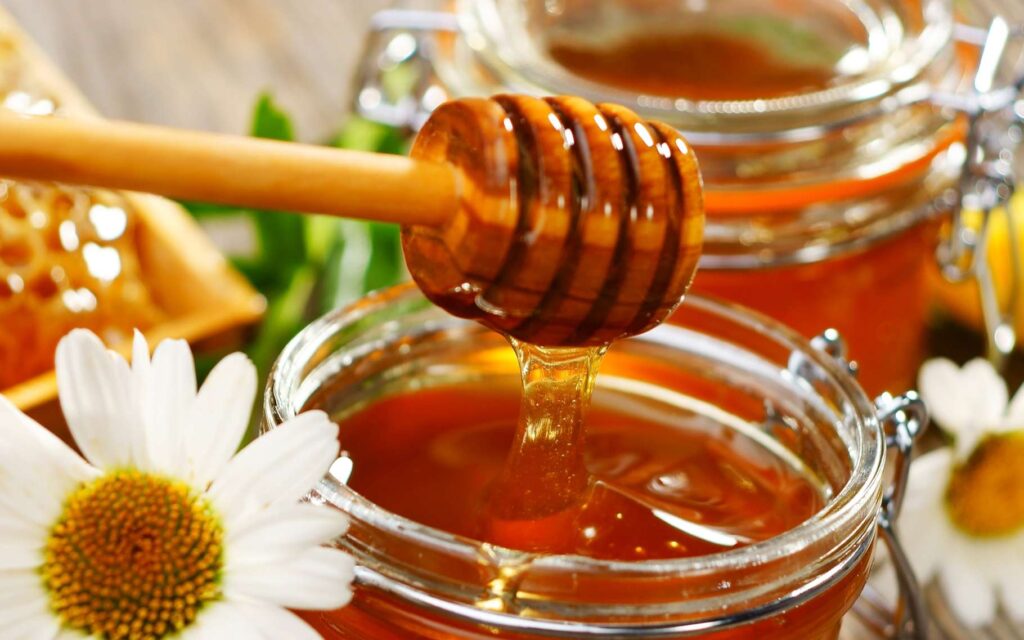
In this short article, we offer you a brief overview of its nutritional, caloric, and energetic characteristics!
Honey: origin and manufacturing process
At the risk of stating the obvious, it is appropriate to re-establish the framework around which we will support the argument. It is a very sweet substance produced by bees from nectar or honeydew. This substance is used by bees as a food reserve and as a staple food for the larvae.
As unappealing as it may sound, magic also happens within the bee’s own body.
The process of honey production by bees is as follows:
- The bee collects the nectar (or honeydew) and stores it in its crop.
- On the way back to the hive, an enzyme secreted by the bee is added to the nectar or honeydew present in the crop. This is the occasion for a chemical reaction that produces glucose and fructose.
- In the hive, the bee transfers the contents of its crop to another bee which mixes saliva and digestive juices with it. This step is repeated several times.
- It is stored in wax cells and then freed from its excess water thanks to the air current generated by the beating of the wings of the ventilating bees. It is when the cell is completely full that the bees create a cover to ensure its preservation.
As for the difference between nectar and honeydew. Nectar comes from flowers while honeydew comes from the droppings of aphids feeding on the sap of plants. These sweet droppings are also collected by bees, and give what is called “fir honey”.
Nutritional and energy values
Now that you know more about the nature of the product, let’s take a look at its nutritional characteristics. It is a natural and pure product, rather rich in energy: it contains two types of sugars: glucose and fructose.
Contrary to popular belief, it is not lower in calories and sugar than classic white sugar, which is so often criticized.
On the other hand, it has been recognized that honey has a greater sweetening power which helps to limit the dose incorporated into food. Only under this condition could it be considered better for the line than sugar.
Also, just like classic sugar, it is the enemy of teeth. Like all glucose-based products, it can promote the formation of cavities. However, extra care must be taken, because its acidity is also likely to promote the erosion of tooth enamel. So you should not overdo it if you want to have beautiful teeth.
In itself, it is a product shrouded in mystery that has always aroused admiration among men. Considered a divine nectar, it has been crowned with many virtues, some of which may be questionable. Still, from a nutritional point of view, it is not a “miracle food” for the figure or health.
Without presenting any particularly remarkable nutritional particularities, it nevertheless appears less harmful than many other products (e.g. white sugar) on many points. We can at least recognize that!
Beyond its nutritional aspects, it also has interesting properties on a medical level. It is a natural source of antioxidants and a substance with recognized antibacterial properties. A major element to compare it to other sweetening products that cannot say the same!
There are different types of honey, Are you a nature lover and environmental activist? You could also benefit from the flavor and benefits of a local product while working to save the bee! To do this, look into beehive sponsorship.
