

Say goodbye to bad eating habits! Sometimes, without even realizing it, we maintain old habits that tip the scales in the wrong direction. Outsmart these bad eating habits and finally get rid of those extra pounds.
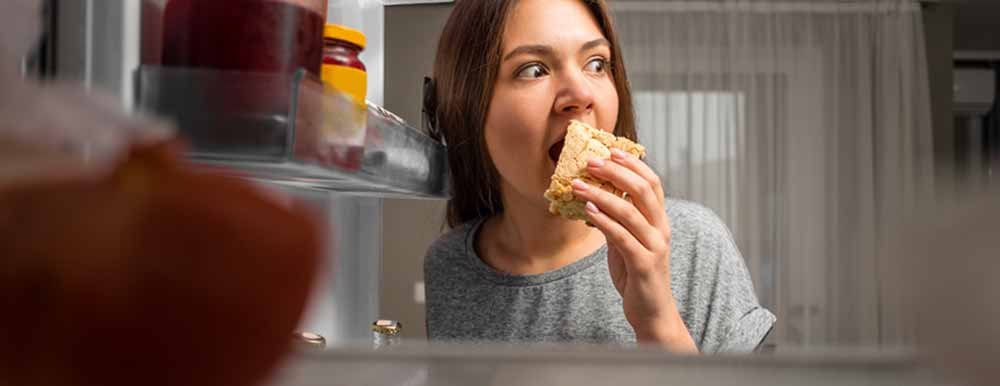
1. You eat quickly and a lot
This often leads you to take seconds. You don’t know the feeling of satiety. When you start eating and your stomach fills up, it takes about fifteen minutes for your brain to produce satiety hormones and allow you to feel full.
If you don’t respect this timeframe, if you eat your meal too quickly, you generally eat more than your body needs, and your digestion is often difficult: bloating, abdominal pain, persistent discomfort after eating. You don’t gain much from it, except perhaps extra pounds.
Furthermore, you didn’t enjoy the pleasure of the meal. By gulping down your food, you didn’t appreciate its taste or texture.
How to change?
You need to learn to take your time, even if you’re in a hurry. Mealtime is a special moment in your day, a moment just for you, meant to protect you for a few moments (at least 15 to 20 minutes) from the hustle and bustle of daily life. You’ll reap many benefits, starting with weight loss. It’s simply a matter of organization. Sit down. Standing isn’t a comfortable position for eating and encourages quick food intake. In the beginning, place your watch near your plate and allow yourself at least 20 minutes to eat your meal.
You can also use the “fork trick.” Take a bite and put down your fork. Swallow slowly after chewing your food thoroughly. Then pick up your fork again to prepare the next bite. It’s a good way to extend the time spent at the table.
2. You snack
The quality of the meal preceding the snacking
This meal is often insufficient in quantity or unbalanced in quality. Sometimes it’s even skipped altogether. Take the example of lunch consisting of a classic sandwich, a dessert, and a soda. The calorie count is very high because of the significant intake of fats and rapidly absorbed sugars. But it doesn’t provide a feeling of fullness.
Indeed, if your meal is high in fat, you’ll be hungry again a few hours later. This opens the door to snacking. The foods you then choose rarely correspond to the definition of a balanced diet. They are comfort foods (chips, store-bought cakes, etc.) that are often addictive.
The environment
Even if you’re not really hungry, you might be tempted. Your children might be having a snack, and suddenly you’re ready to dive into the packet of cookies. You might also “accidentally” open the refrigerator and come face to face with a delicious piece of Gruyère cheese or a chocolate mousse. That’s the beginning of the disaster, because nothing and no one will stop you.
Even if you resist these temptations, other dangers await you. A house to tidy, dinner to prepare, when all you want to do is lie down on your sofa and do absolutely nothing. But duty calls, and food acts as a ” boost .” You may feel the need to ” recharge your batteries ” to face all your obligations and turn to foods high in sugar and fat.
Your day also influences your eating habits. Stress, frustration, or fatigue can lead you to seek a moment of calm and comfort. You pull out a bottle of wine, some peanuts, and off you go! So much for your dream figure!
How to change?
- Choose a lunch that promotes satiety. It should contain filling foods and be limited in hidden fats.
- Plan a snack for when you get home. It can be savory or sweet, as you prefer, but it should consist of foods that, while tasty, are low in calories. → See also: My healthy snack ideas
- Allow yourself a reasonable amount of these foods, according to your appetite. Know when to stop, even if you don’t feel full. Nature being what it is, you’ll see that about ten minutes later, you won’t feel like eating at all, and your hunger pangs will be nothing but a bad memory.
3. You eat out of boredom
We don’t eat simply to satisfy hunger. Those who know how to eat as soon as they feel the need and stop as soon as they are full generally don’t have weight problems. The act of eating is the result of many causes. Boredom is one of them.
Eating is just another activity. By eating, we fill a void. Food provides comfort and keeps us occupied. But the calorie count adds up, sometimes significantly. We lose the rhythm of our meals. We eat all day long. Nutritional balance is forgotten. Weight gain can be alarming.
How to change?
We must declare war on this way of eating, which often doesn’t even please you and triggers feelings of guilt. And declaring war means first and foremost having a strategy.
- Get out of the ” risk zone ” . Don’t linger at home, especially near the kitchen, the place of all temptations. Go for a walk. Organize activities.
- Empty your cupboards of risky products. Because, even if you can’t always leave the house, at least your home shouldn’t be your worst enemy. So throw away anything that might be too fatty or too sugary. Store-bought cakes, crisps, and processed meats should disappear from your daily routine. Instead, prepare a basket of fresh fruit.
4. You eat to compensate
A difficult and stressful day, hurt feelings, frustration—all these negative emotions can lead you to eat even when you’re not hungry. I call this the ” double whammy. ” You’ve been through some tough times, and you take it out on the refrigerator, resulting in a higher weight on the scale and an even lower mood.
How to change?
You need to break free from this vicious cycle. Yes, you need to treat yourself, especially if the preceding hours have been unpleasant. Avoid being in front of a vending machine or in a kitchen, as your current state of mind prevents you from calmly enjoying food. So, find a way around the obstacle. Think about what you enjoy—a workout, a massage, a blow-dry, or an hour of shopping.
5. You eat at night
Night Eating Syndrome is often underestimated because patients don’t talk about it. Yet, it can lead to significant weight gain. It’s a difficult problem to solve and requires therapeutic intervention (cognitive behavioral therapy).

