

If there’s one weight training exercise everyone knows, it’s this one. The bench press is a basic exercise that primarily targets the pectoral muscles.
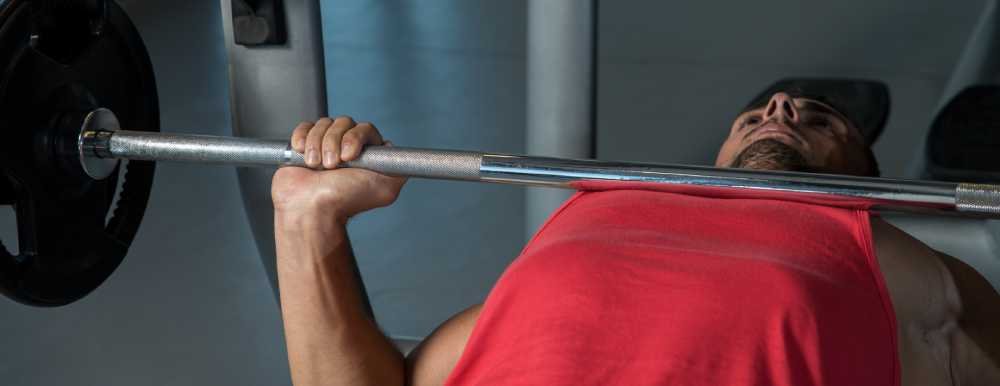
In this article, I’m going to guide you on how to progress, in order to (perhaps) reach the symbolic 100 kg mark in the bench press.
1. Eat to grow
In bodybuilding, the main factor in gaining strength is your weight. If you’ve been training for several years and have fluctuated your weight since you started, you know what I’m talking about.
The more our body is in an environment of caloric abundance, the less it tries to conserve them for survival. Typically, when bulking up, you will be stronger than when in a caloric deficit.
This also applies in the short term: if you eat an extra 2000 kcal over the weekend, your training the following week will be surprisingly more productive. This is especially true for pressing exercises, as they are intrinsically linked to your body weight.
The first step to bench pressing 100 kg is to be in a calorie surplus (even a slight one). Trying to increase the weight of this exercise when you’re in a deficit is unrealistic (unless you’re a beginner).
2. Force to push
It seems logical, but once you reach a certain training level, stagnation gradually sets in. Every day at the gym, I see people concentrating body and soul to maintain perfect technique, no matter the exercise. That’s fine, but it’s for beginners! Beyond a certain level of strength, the technique is usually well-developed.
Mastering proper exercise technique is essential for long-term success in bodybuilding. However, after reaching an intermediate level, progression should be geared towards slightly less precise execution.
When you’re a natural weightlifter, the weight you lift is directly related to your muscle mass. In this context, a slight bounce on the chest, the bar tilting by 2 cm; your glutes lifting off the ground… you have to accept that your technique will deteriorate if your goal is a 100 kg bench press.
3. Stable support is essential
Lifting heavy weights is good, but bouncing a 100 kg barbell on a glass table will inevitably break it. That’s why strengthening the stabilizing muscles involved in this movement is essential.
The bench press position can be broken down as follows:
- Shoulder blades pulled together,
- Low shoulders, open cage
- Feet flat on the ground,
- Glutes, trapezius muscles and head in constant contact with the bench.
The muscles antagonistic to those recruited during the bench press serve as support and must be at least as muscular as the agonist muscles of the bench press (= the pecs).
To ensure stable support, I encourage you to include twice as many pulling exercises as pressing exercises in your weight training. In the long run, this will guarantee good shoulder health, as well as a more stable and optimal position for your pressing exercises.
4. Basic progression cycle for the bench press
If you haven’t yet reached “heavy” bars (I know, this notion is relative) on the bench press, I strongly encourage you to stay basic on your progression cycles.
Here is the type of cycle that is suitable for almost all practitioners ( example for a beginner/intermediate individual, 70kg body weight, current maximum 90kg ):
| Week 1 | 4 x 10 x 65 kg | Validated, difficulty 7 |
| Week 2 | 4 x 10 x 66 kg | Validated, difficulty 7 |
| Week 3 | 4 x 10 x 67 kg | Validated, difficulty 9 |
| Week 4 | 4 x 10 x 68 kg | Validated, difficulty 9 |
| Week 5 | 4 x 10 x 69 kg | Failure |
| Week 6 | 4 x 8 x 69 kg | Validated, difficulty 7 |
| Week 7 | 4 x 8 x 70 kg | Validated, difficulty 8 |
Simple but effective.
The four-set base remains throughout the cycle. We start with 10 repetitions and an easy weight. Each week, 1kg is added to the bar.
The week you fail, you start again the following week with the same weight but in an 8-repetition format. The next time you fail, you reduce to a 6-repetition format.
On average my students progress over 30 weeks with this type of cycle (some specifics are added).
When you fail the 6 repetition format: start again at 10 with an appropriate load.
In practice, if our individual pushes the progression to 6 x 88, they will restart their cycle at 4 x 10 x 70. Trying to make things too complicated is often counterproductive.

