

Spinal Muscular Atrophy Type 1: The Story Changed, and We’re Still Catching Up
If you rewind the clock just ten or twelve years, which is basically yesterday in medical terms. Spinal Muscular Atrophy (SMA) Type 1 wasn’t really treated. It was managed.
And “managed” is a generous word. It was effectively a countdown. Doctors knew the trajectory with heartbreaking accuracy: parents were told to prepare for the worst, and care focused almost entirely on comfort, nutrition, and breathing support. We didn’t offer treatments because, quite frankly, the cupboard was bare.
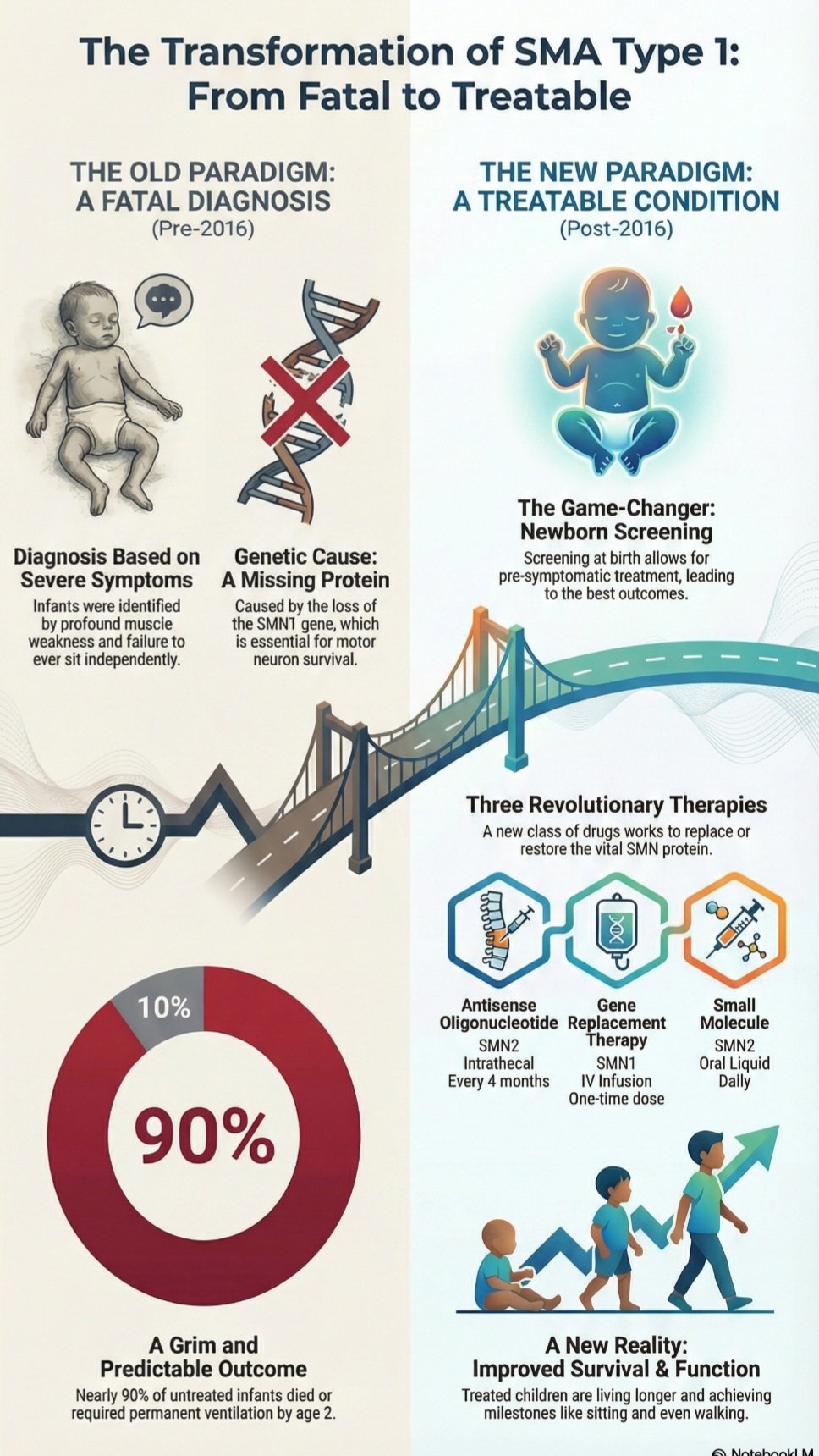
That framing doesn’t hold up anymore.
The shift has been unnervingly fast, even for those of us who work in rare diseases. Today, we talk about SMA Type 1 as a treatable, chronic condition. That label still feels a bit tentative to some clinicians, and for good reason, but it reflects a massive pivot driven by three things colliding at once: drugs that actually fix the genetic mechanics, newborn screening that catches babies before they get sick, and clinical guidelines that seem to need rewriting every six months.
This isn’t medical advice, think of it more as a guided tour through how SMA Type 1; works, how we used to handle it, and why the current reality is a lot messier, but significantly more hopeful than the old textbooks ever predicted.
The Genetic Glitch
At its core, SMA is about motor neurons, which are the cells that carry the “move” orders from the spinal cord to the muscles. In SMA, these neurons slowly check out as they die off and the muscles they control; weaken, shrink, and eventually fail. In about 95% of cases, the problem traces back to a single culprit: the SMN1 gene, which usually is the critical piece of this gene (exon 7) is missing entirely. SMN1’s job is to produce the “survival motor neuron” protein, and It’s a bit of a misnomer because the protein does a lot more than just keep motor neurons alive. It’s involved in basic cell maintenance (specifically the spliceosome, if you want to get technical). But for reasons we still don’t fully understand, motor neurons are incredibly dramatic when they don’t get enough of it.
Here is the twist, though: humans have a backup gene called SMN2. On paper it looks nearly identical to SMN1, but in practice there’s a single letter difference in the genetic code that messes up the instructions. It’s like having a spare tire that’s already flat. SMN2 produces protein, but about 85% to 90% of it is unstable junk that the body breaks down immediately. This is why the number of SMN2 copies a child has is such a big deal. One or two copies? Usually not enough to keep neurons alive past infancy. Three or four copies? The disease is softer. More than that, and you might not see symptoms until adulthood.
That one variable how many backups a kid has, ends up dictating almost everything that happens next.
How We Used to Classify It (The Grim Days)
We used to call this “Werdnig Hoffmann disease”, named after the doctors who first described it in the late 1800s. Their observations were brutal but precise: babies who got weak in the first few months, never sat up on their own, and didn’t survive long.
For decades, the classification system was rigid. If symptoms started before six months and the child never sat independently, it was Type 1. It was a simple, internally consistent system. The treatment options, however, were nonexistent. We did what we could. Non-invasive breathing masks, feeding tubes when swallowing got scary, physical therapy to keep limbs loose. But we knew the score. Without aggressive respiratory support, most children didn’t make it to their second birthday. Even with it, permanent ventilation was often the endgame. This history is important because a lot of the current arguments about quality of life, cost, and long-term expectations, are hung over from this era.
What It Actually Looks Like
You’ll often hear clinicians use the term “floppy infant.” It sounds casual, maybe even a little crude, but the physical findings are striking. Muscle tone is just… absent. If you lay an infant with untreated SMA Type 1 on their back, their legs often fall open to the sides frog-legged, because there isn’t enough strength to fight gravity. Breathing is the other tell. The diaphragm usually works okay at first, but the muscles between the ribs (intercostals) don’t. So when the baby inhales, the chest sinks in while the belly pops out. It’s called paradoxical breathing, and once you’ve seen it, you don’t forget it, reflexes are gone. You might see the tongue twitching, which is a sign that the nerves in the brainstem are struggling. To an experienced eye, none of this is subtle. But in a newborn who isn’t really moving around much yet, it can be remarkably easy to miss.
The Diagnosis Pivot
I remember when diagnosing this meant a muscle biopsy. We’d have to surgically remove a piece of muscle from an already weak baby to look for signs of nerve loss, but thankfully, that era is over. Now, it’s a blood test. We use genetic testing (PCR or MLPA) to see if SMN1 is missing and, crucially, to count those SMN2 backup copies. In a small handful of cases(maybe 5%)the gene isn’t missing, it is just mutated in a subtle way. Those take a bit more digging to find. But for almost everyone else, we get the answer from a blood draw, not a scalpel.
When SMA Became an Emergency
The first real therapy was approved in 2016, and that moment forced a total philosophical shift in neurology. Suddenly, SMA wasn’t something you watched unfold. It was something you had to interrupt immediately, but here’s the catch; motor neurons don’t regenerate, once they’re gone, they’re gone. That reality turned timing into the only metric that mattered. Waiting a few weeks could mean the difference between a child who walks and a child who never sits up. We moved from reactive care to “time is neurons” urgency.
The Toolkit: Three Therapies
We now have three FDA approved ways to tackle this. They all try to boost SMN protein, but they take different roads to get there.
Nusinersen (Spinraza): The first one on the scene. It’s a piece of genetic code that acts like a patch for the “typo” in the SMN2 backup gene, helping it make more functional protein. It has to be injected directly into the spinal fluid, and it requires lifelong dosing.
Onasemnogene abeparvovec (Zolgensma): This is the gene therapy. It uses a hollowed-out virus to deliver a working copy of SMN1 into the cells. It’s a one time IV infusion approved for kids under two. The concept is elegant: just replace the missing part. (Though questions about how long it lasts are still being studied).
Risdiplam (Evrysdi): A daily oral liquid. Like Spinraza, it messes with the splicing of the backup gene to boost protein output. Because it goes through the whole body, not just the spine, it might help tissues outside the nervous system, which is a growing area of interest.
None of these are perfect, but all of them are vastly better than nothing.
Clinical Trials vs. The Real World
If you look at the trial data, it looks miraculous. Babies who would have been paralyzed were sitting, some even walking. The survival numbers shot up, but trials pick the perfect candidates. Real world data is a bit more textured, and registry data suggests that outcomes depend heavily on when you catch it. If a child is already showing symptoms when treatment starts, they usually stabilize and improve, but they rarely return to a “normal” baseline. They might still need feeding tubes or breathing support at night,
It’s not a failure of the drug; it’s just biology asserting its limits.
Newborn Screening: The Game Changer
Honest opinion? The drugs are great, but newborn screening is what actually changed the game. Testing for SMA using the dried blood spot from a heel prick allows us to find these kids before they lose neurons. The data on pre symptomatic treatment is mind-blowing. We have children with “Type 1” genetics who are walking, running, and hitting milestones right on time. They don’t look like patients, It’s not flawless some rare mutations slip through, but it has effectively turned SMA from a clinical diagnosis (based on symptoms) to a genetic one (based on DNA).
The Elephant in the Room: Cost
We can’t talk about this without talking about money. Zolgensma’s list price is over $2 million. The other drugs require lifelong spending that stacks up fast. Health economists argue and they’re probably right, that the upfront cost is cheaper than a lifetime of intensive care, hospitalizations, and specialized equipment. But that doesn’t make the sticker shock any easier for healthcare systems to swallow, and globally Access is incredibly uneven. In many parts of the world, these breakthroughs might as well be science fiction.
Living Longer, but How?
Parents always ask: How long will my child live now? For untreated SMA, we had charts and averages. For treated kids? We’re honestly guessing. The first generation of treated infants is just now hitting school age or adolescence. We don’t have 30 year data because the drugs haven’t existed for 30 years. We’re seeing that “survival” and “function” are two different things. A child might live much longer but still face orthopedic issues like scoliosis, or fatigue, or weaker hip muscles. We’re in uncharted territory..
A New Population
Success has created a new challenge: a growing population of teens and older kids with Type 1 SMA who, historically, wouldn’t have survived. They don’t fit into our old boxes, and we’re having to develop new ways to measure their quality of life, focusing on things like endurance, technology use, and independence rather than just “can they sit?”
Where Do We Go From Here? The field seems to be moving toward; combination therapy, does using gene therapy, plus a splicing modifier work better than one alone? Maybe. It makes biological sense, but we don’t have definitive proof yet, as there is also a push to look beyond the SMN protein treatments that target muscle strength directly or protect the neurons themselves. It’s an admission that fixing the root cause (the gene) doesn’t always fix everything downstream.
A Closing Thought
SMA Type 1 didn’t become simple when we found a treatment. In many ways, it got more complicated; ethically, economically, and clinically. But the shift is profound. A diagnosis that used to be a conversation about end of life care is now a conversation about options, timing, and rehabilitation. It’s messy, and the story is still being written, but for the first time, it’s a story that actually has a future.

