

Following a minor sprain, if you’re walking again after a few days, rehabilitation isn’t necessary. However, after a severe sprain or a fracture, you might spend several weeks, or even months, unable to move a leg. Rehabilitation then becomes absolutely essential to restore strength and tone to your muscles. It’s a period that can be difficult, painful, and sometimes very long, but it’s a process that can’t be avoided.
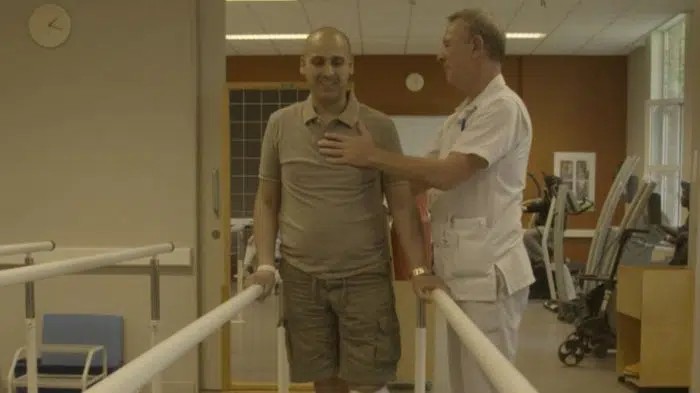
Why is leg rehabilitation important?
Simply because if you start again with a weaker leg, you expose yourself to all sorts of problems. A relapse of a sprain is to be expected, but you can also injure the ligaments, which are then poorly protected by the muscles.
This also poses a problem for the opposite leg, which is under much greater strain to compensate for the weakness of its injured counterpart. Ultimately, the entire body can suffer, with balance problems potentially leading to back problems.
The course of rehabilitation
Rehabilitation should begin as soon as possible. Ideally, within the first week after a sprain, and right after a cast is removed for a fracture. For a ligament tear, rehabilitation will begin when your doctors deem you ready.
We always start with a physiotherapist. Initially, it’s quite pleasant, as they prepare the leg with lymphatic drainage massages that help reduce inflammation. The first sessions are therefore generally quite enjoyable, even if the physiotherapist sometimes twists us slightly to check our flexibility.
The sessions will then gradually become more challenging. The patient must perform various exercises designed to strengthen their muscles and improve their stability. Depending on the length of immobilization, the client’s age, and the nature of their injury, there will be a minimum number of sessions required. For a severe ankle sprain, approximately twelve sessions will be necessary, while for a tibia-fibula fracture, rehabilitation will generally be longer.
Train alone and resume your activity
Initially, you’ll use the equipment available at the physiotherapist’s office. They will guide you through the process and show you which exercises to perform. Then, when they feel you’re ready, they’ll give you the go-ahead to gradually resume your sport.
Next, the most effective way to regain maximum feel for the sport will be to resume your usual activity, unless your doctor or physiotherapist advises otherwise. Of course, this return to activity must be gradual. You should never jump back into competition immediately, and you’ll need to train for a few weeks to fully regain confidence in your abilities and your leg.
Self-rehabilitation is equally essential.
After the mandatory physiotherapy session, the self-rehabilitation period will be essential to regaining 100% of our abilities. This is especially true in the case of prolonged immobilization for an athlete.
To do this, seek advice from the physiotherapist you worked with previously. They will recommend a series of exercises to do at home to gradually regain your full abilities.
Certain devices will be very useful for continuing rehabilitation at home, especially alongside physiotherapy sessions. The patient will then progressively regain their usual muscle strength.
Rehabilitation can be a long and arduous journey, but it can also become a true source of motivation and change your lifestyle for the better. Indeed, many people have become athletes while recovering from an injury. They have developed a taste for sport and physical exertion, and are therefore stronger after their injury.

