

Still relatively unknown, auriculotherapy belongs to the field politely referred to as alternative, complementary, or non-conventional medicine. It involves stimulating specific points in and around the ear to relieve pain, reduce anxiety, or treat addictions and various disorders. All the more reason to say: auriculotherapy is about hearing!
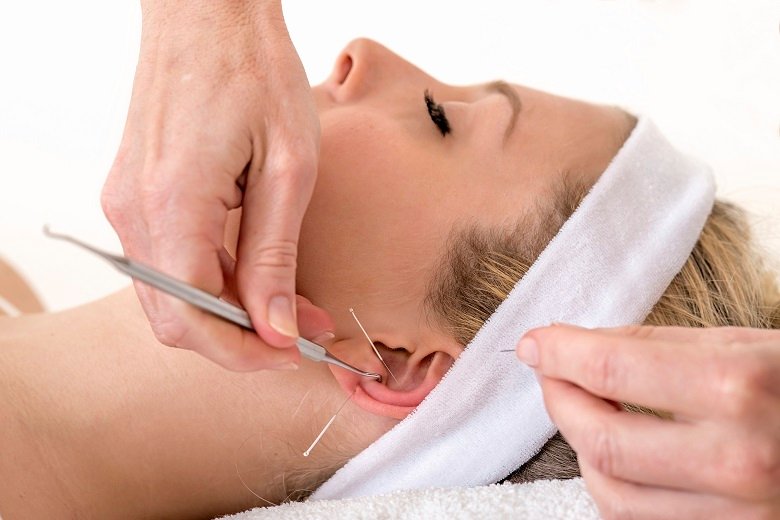
What is meant by auriculotherapy?
Auriculotherapy – the term “auricular” referring not only to the little finger but also to anything related to the ear – belongs to the family of techniques parallel to acupuncture, which also includes acupressure, reflexology, and psycho-bio-acupressure. It also utilizes the principles of meridians, the body as an electrical network, and energy rebalancing.
The underlying principle of auriculotherapy is that the ear resembles an inverted fetus; thus, it represents a kind of map of the entire body, with different points corresponding to organs or viscera. These pressure points are stimulated by needles or cold, acting directly on the pain or ailments for which the patient seeks treatment.
Don’t turn a deaf ear to the pain
Like acupuncture, auriculotherapy has its roots in traditional Chinese medicine, as it relies on touching specific points. But it was a Frenchman, Dr. Paul Nogier, who rediscovered it in the 1950s. Using his own body as a testbed, he recorded each point on the ear corresponding to a specific type of pain.
If our body functions like an electrical network, with the brain as its origin and destination, then the ear occupies a strategic position: at the level of the brainstem, the switching point for all the information circulating in our body. The messages, which travel up and down like tubes, are displayed on the ear along their path.
Read Also Our tips for optimal health
Nogier thus mapped the auricle of the ear and identified around forty pressure points. Two decades later, Chinese researchers continued his work and added some 100 more points. Among the messages that circulate in our body are those of pain, the crux of auriculotherapy.
Against the skeptics and the hard of hearing
Because auriculotherapy has a therapeutic purpose. It aims to relieve pain and reduce the symptoms of stress. This technique is particularly indicated for:
- Relieving acute or chronic pain
- Calming allergies
- Helping with addiction treatment (drugs, alcohol, tobacco)
- Reducing the impact of anxiety
- Combating sleep disorders
- Supporting a desire to lose weight or regulate one’s appetite
To do this, the therapist uses a detector during a session that records the potential differences in the ear – similar to an electrical circuit. This device reveals the precise point corresponding to the area of pain indicated by the patient.
Next, this point must be stimulated with a needle or nail, or liquid nitrogen injected, to stimulate the reflex zone, which will then activate the pain inhibitory controller in the affected area. Auriculotherapy allows us to rediscover how to activate this inhibitory control, which is ingrained within us, but whose workings we are unaware of.
Who can practice auriculotherapy?
Since there are no regulations governing the profession, any practitioner can offer you auriculotherapy sessions, including specialists in alternative medicine. However, if the treatment is poorly administered, it can trigger other problems without relieving the underlying pain.
It is therefore best to consult a physician-acupuncturist first, someone who already understands the principles of energy rebalancing through pressure points. Depending on the nature and intensity of the pain or symptoms, the therapist can suggest using different techniques:
- Needles (like for acupuncture);
- Semi-permanent needles (which are left in place for 1 to 2 weeks);
- Magnets (for electromagnetic stimulation);
- Injections of liquid nitrogen (sensation of cold);
- Massages.
However, two things should be noted. First, auriculotherapy may be poorly tolerated by pregnant women, the elderly and frail, patients with autoimmune diseases, or people with heart problems. In each of these cases, other alternative therapies may be recommended.
Next, and most importantly, it’s crucial to understand that this technique works best when the pain is recent and the patient isn’t taking excessive medication. Medications tend to inhibit our ability to respond to pain, thus reducing the impact of pressure points.
In short, auriculotherapy is very good, but as a first-line treatment rather than a last resort. When done correctly, it will certainly help bring a smile back to your face… from ear to ear.

