

Expectant or new mothers, are you aware of the importance of the pelvic floor? Located in the perineum, this muscular hammock supports your torso and controls your sphincters. However, during pregnancy and childbirth, it undergoes significant pressure that stretches and weakens it. The result: possible urinary incontinence, pelvic pain, or even pelvic organ prolapse. To prevent this, your gynecologist will prescribe perineal rehabilitation sessions 6 to 8 weeks postpartum. Here are also 5 exercises you can do at home after your baby arrives:
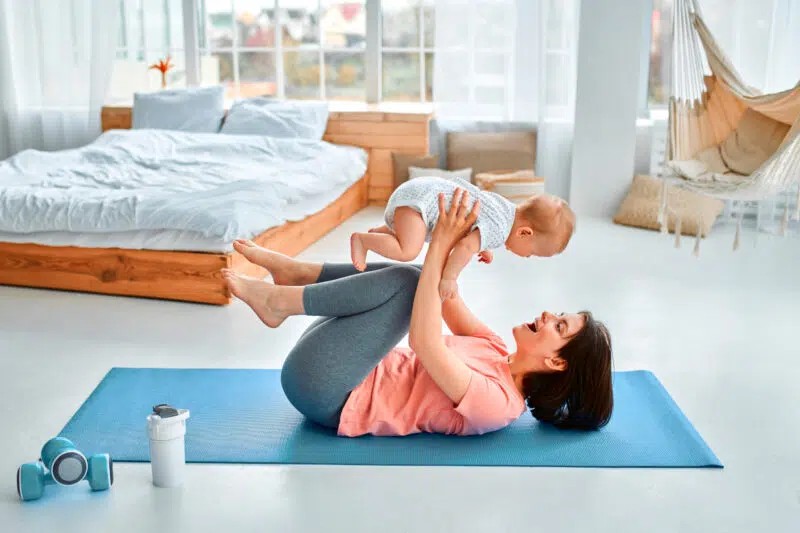
1. Diaphragmatic breathing
Let’s start with a gentle exercise based on diaphragmatic breathing. The pelvic floor works in coordination with the abdominal muscles and the diaphragm to stabilize the torso.
After a vaginal or cesarean delivery, diaphragmatic breathing is excellent for restoring this synergy. This coordination is significantly impacted by pregnancy…
Follow these tips to practice diaphragmatic breathing :
- Sitting or lying on your back, place one hand on your chest and the other on your abdomen.
- Inhale deeply through your nose, feeling your belly rise, and your perineal muscles relax.
- Exhale slowly through your mouth: your stomach and perineum will contract from bottom to top.
- Repeat 15 times.
2. Isometric contraction of the lower abdomen
Equally gentle but more targeted, try this isometric lower abdominal contraction exercise. It will help gently restore the abdominal wall by tightening the muscle fibers that pregnancy has stretched.
During your abdominal contractions, keep your pelvis in a neutral position:
- Lying on your back with your knees bent, draw your navel towards your spine. Press your back flat, without tilting your pelvis too far in.
- Exhale as you press your heels into the ground.
- Hold the contraction for 5 seconds, then release your heels while inhaling gently.
- Do 10 repetitions.
3. Kegel Exercises
Next, you can continue the Kegel exercises you started with your pelvic floor physiotherapist. The goal is to restore tone to your pelvic floor and maintain it over time.
By first undertaking sessions with a professional, you will learn to correctly identify and contract/relax your pelvic floor muscles. Once you have mastered the basics, you can then increase the difficulty at home. Vary the contraction and rest periods, the number of repetitions, and so on.
In addition to strengthening the pelvic floor, Kegel exercises will also help restore your abdominal wall.
Here is the basic method:
- Lying on your back, exhale gently while pressing your stomach in.
- Tighten your perineum from the entrance of the vagina down into your lower abdomen. Keep your pelvis still.
- Hold the contraction for 5 seconds, then release completely. Your pelvic floor will “descend”.
- After a 10-second rest, repeat. Do this sequence about ten times.
For an added challenge, raise your legs to 90 degrees while pressing your feet against a wall.
4. Dynamic Clamshell Sheathing
Also, try the dynamic side plank Clamshell. This pelvic floor exercise will strengthen the glutes, external hip rotators, and back and pelvic stability.
By coordinating your abdominal and gluteal muscles:
- Supporting yourself on your forearm, lie on your side and bend your legs at a 45-degree angle.
- Engage your core and glutes to lift your top knee while keeping your feet together.
- Lower your knee and repeat 10 times on each side.
5. Pectoral muscle stretch
Finally, whether you breastfeed or bottle-feed your baby, you often have rounded shoulders. Therefore, stretching your pectoral muscles can prevent chest tension and improve posture, while also reducing neck and back pain.
- Lie on your back with your arms on the floor in a Y position.
- Stay like that for 2 minutes.
- Bring your arms to a 90-degree T position, then hold for an additional 2 minutes.
Repeat all these exercises twice a day, in 10- to 15-minute sessions. Taking this short time for yourself will be as beneficial for your well-being as it is for your baby’s.

