

The Proposed “Capture-Recapture” Cycle
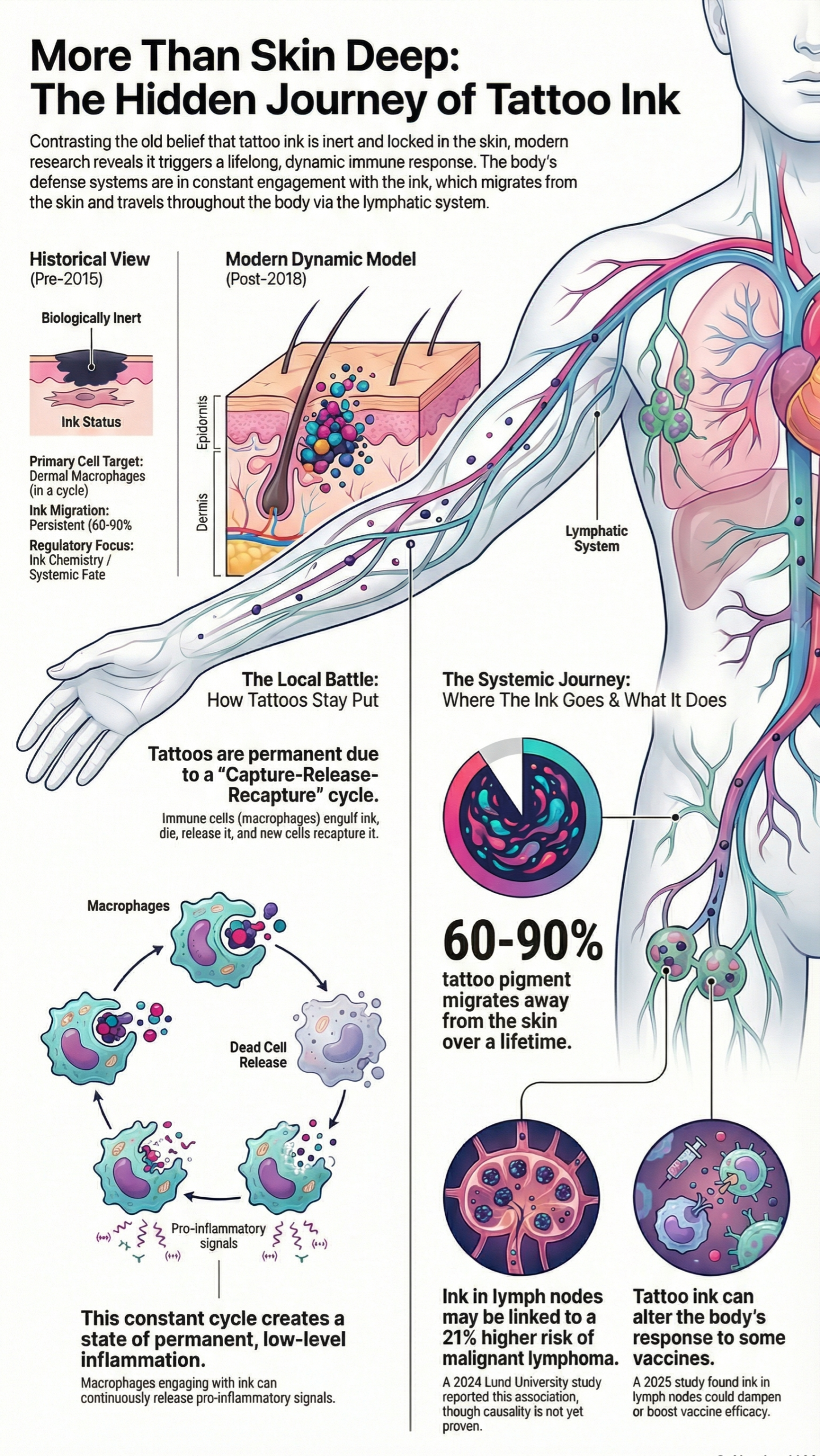
Recent immunological research has moved away from the idea that tattoo ink is just a static stain. Instead, studies like those led by Baranska et al. suggest that the permanence of a tattoo is actually an active, ongoing process. According to these findings, dermal macrophages cells that act as the body’s scavenger crew swallow the ink particles. Because they can’t break down these synthetic pigments, the ink stays trapped until the cell eventually dies. At that point, the pigment is released and then “recaptured” by new macrophages.
It’s an interesting theory, though it means your immune system might be in a state of permanent engagement with the ink for the rest of your life. On a more mundane note, the actual mechanical process of getting a tattoo needles puncturing the skin about 100 times per second hasn’t changed much despite these new cellular insights.
Migration and Diagnostic “Noise”
While a tattoo looks localized, official summaries of the biological journey of ink indicate that the pigment doesn’t necessarily stay put. Some research estimates that between 60% and 90% of the pigment eventually migrates away from the skin. Within the first six weeks, about 32% of that load can typically be found in the regional lymph nodes.
This leads to a very practical, if somewhat boring, medical hurdle: diagnostic interference. Because ink accumulates in the lymph nodes, they can appear enlarged or “suspicious” on PET scans and MRIs. Surgeons often find themselves having to double-check a patient’s “ink history” to ensure they aren’t misidentifying tattoo pigment as metastatic cancer. For most people, however, these pigmented nodes just exist quietly in the background without causing any daily symptoms.
Contextualizing Health Risks
Lately, research has looked into how this persistent ink might influence broader health, but the findings are often debated.
Vaccine Responses: A 2025 study published in PNAS observed that mRNA-based vaccines might produce a lower antibody response when injected near tattooed areas that share a drainage pathway. Curiously, the same study suggested that certain black and red inks might actually boost the response to inactivated flu vaccines by acting as a sort of accidental “adjuvant.” It’s worth remembering that much of this data comes from mouse models and human cell assays, which don’t always reflect what happens in a living human body.
Lymphoma Concerns: A 2024 population-based study in Sweden noted a 21% higher adjusted risk of malignant lymphoma among the tattooed individuals they tracked. While that percentage sounds significant, clinical agencies are quick to point out that the evidence remains at a “low certainty” level. These types of observational studies often struggle to separate the ink from other lifestyle factors, like smoking or sun exposure, that also impact cancer risk.
The Regulatory Landscape
The chemical makeup of ink has historically been a bit of a “wild west.” A study of 54 US brands found that 45 of them contained unlisted additives, such as industrial surfactants or higher alkanes. There is also the reality that certain dyes can decompose into carcinogenic compounds if they are hit with enough UV light or laser removal treatments.
In response, the Modernization of Cosmetics Regulation Act (MoCRA) and 2024 FDA guidelines are shifting toward a more proactive model. Manufacturers are now being asked to register their facilities and list all ingredients a change that mostly results in more administrative paperwork for the companies involved. While these regulations aim to catch issues like microbial contamination before the ink hits the shop, they don’t do much for the ink mixtures that are already sitting in people’s lymphatic systems.
To visualize this, think of a tattoo not as a painting on a wall, but as a persistent custodial task. The immune system’s “clean-up crew” (macrophages) is constantly picking up the same pieces of debris, unable to throw them away, and passing them to the next generation of workers in a cycle that never really ends.

